Skip to Content Skip to Navigation

The Blog Lip Migration: Why it Happens and What Can Be Done (Without Starting Over)

Mary Chigwidden, Head of Education and Senior Cosmetic Nurse, 5 November 2026

In brief

  • Lip migration happens when previous lip treatment settles beyond where it was placed, softening the lip border or adding fullness above it
  • It tends to show in the weeks after treatment, while normal swelling usually settles within 3–5 days
  • Common causes include top ups placed too close together and placement that doesn’t account for the lip’s anatomy
  • Correction doesn’t always mean starting over – spot treatment, balancing the opposite side and looking at the whole face may be options after assessment

Lip migration is when previous lip treatment moves beyond the area it was placed in, so the lip border looks softer or less defined. It tends to build gradually, which is why many people first catch it in a photo or under certain lighting. At our Sydney and Brisbane cosmetic clinics, our practitioners often meet people who were happy with their lips once and now feel something has changed.

“You don’t necessarily need to start over,” says Mary Chigwidden, Head of Education and Senior Cosmetic Nurse at Contour Clinics. “You’ve already invested a lot in your lips and there are often other ways.”
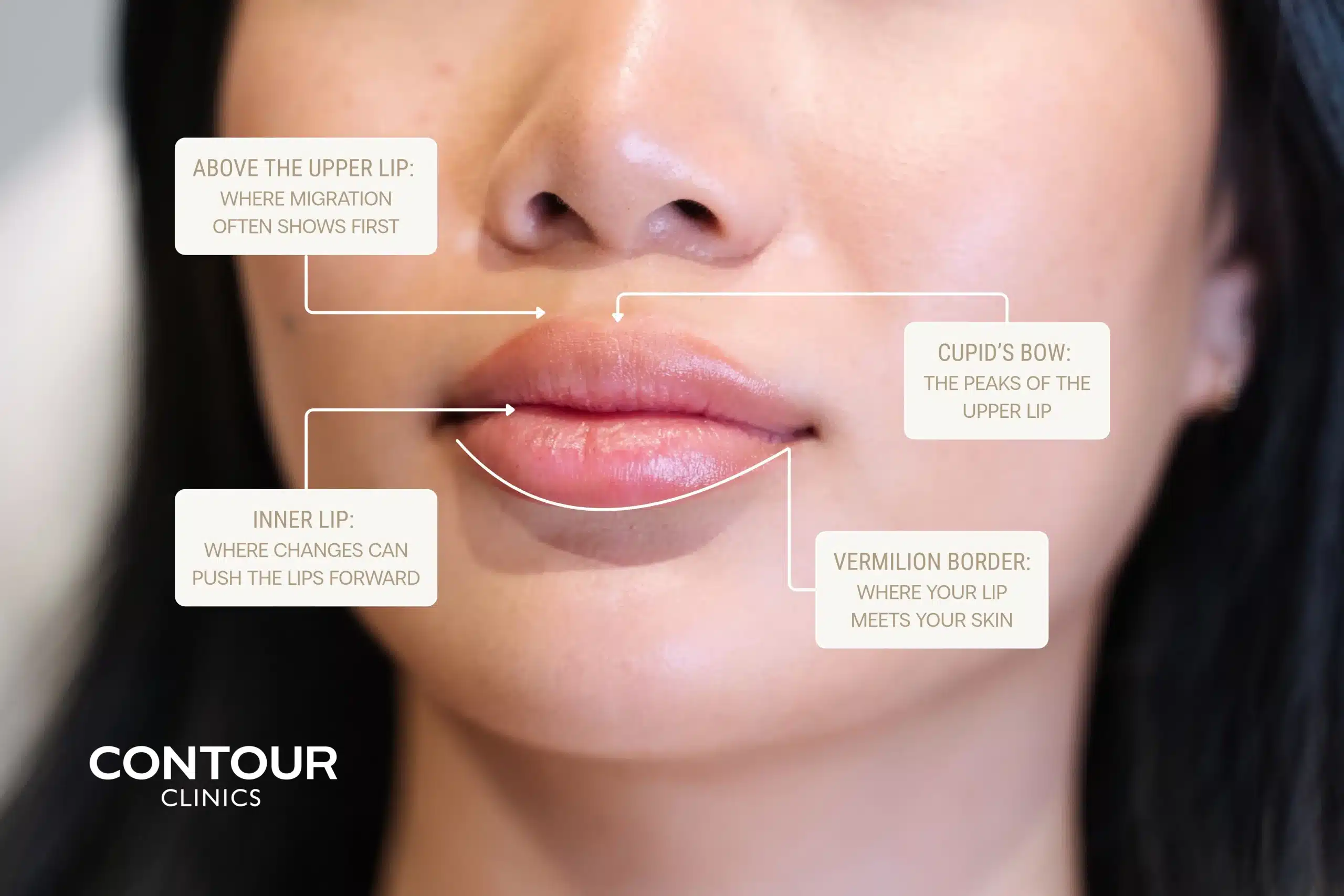
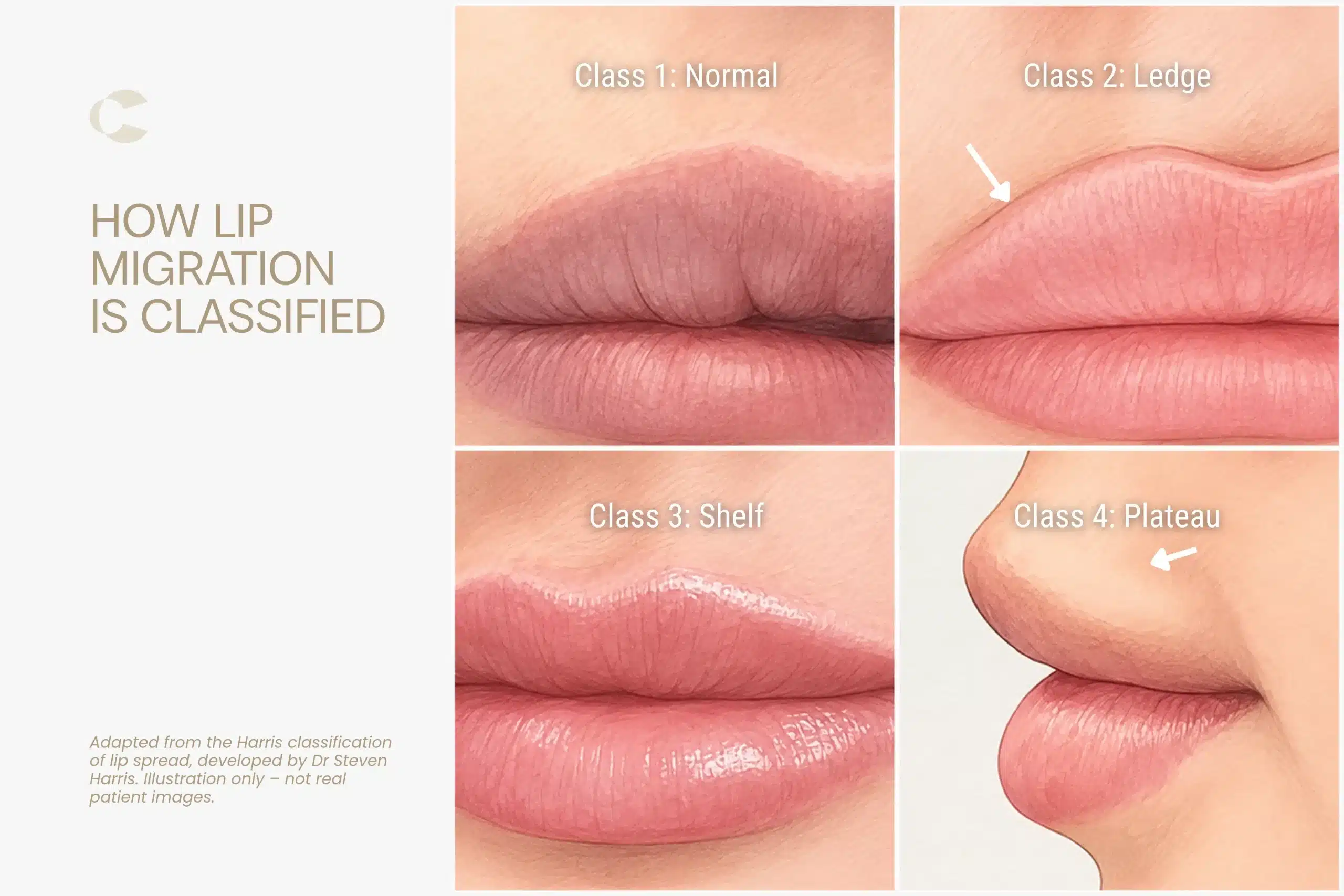
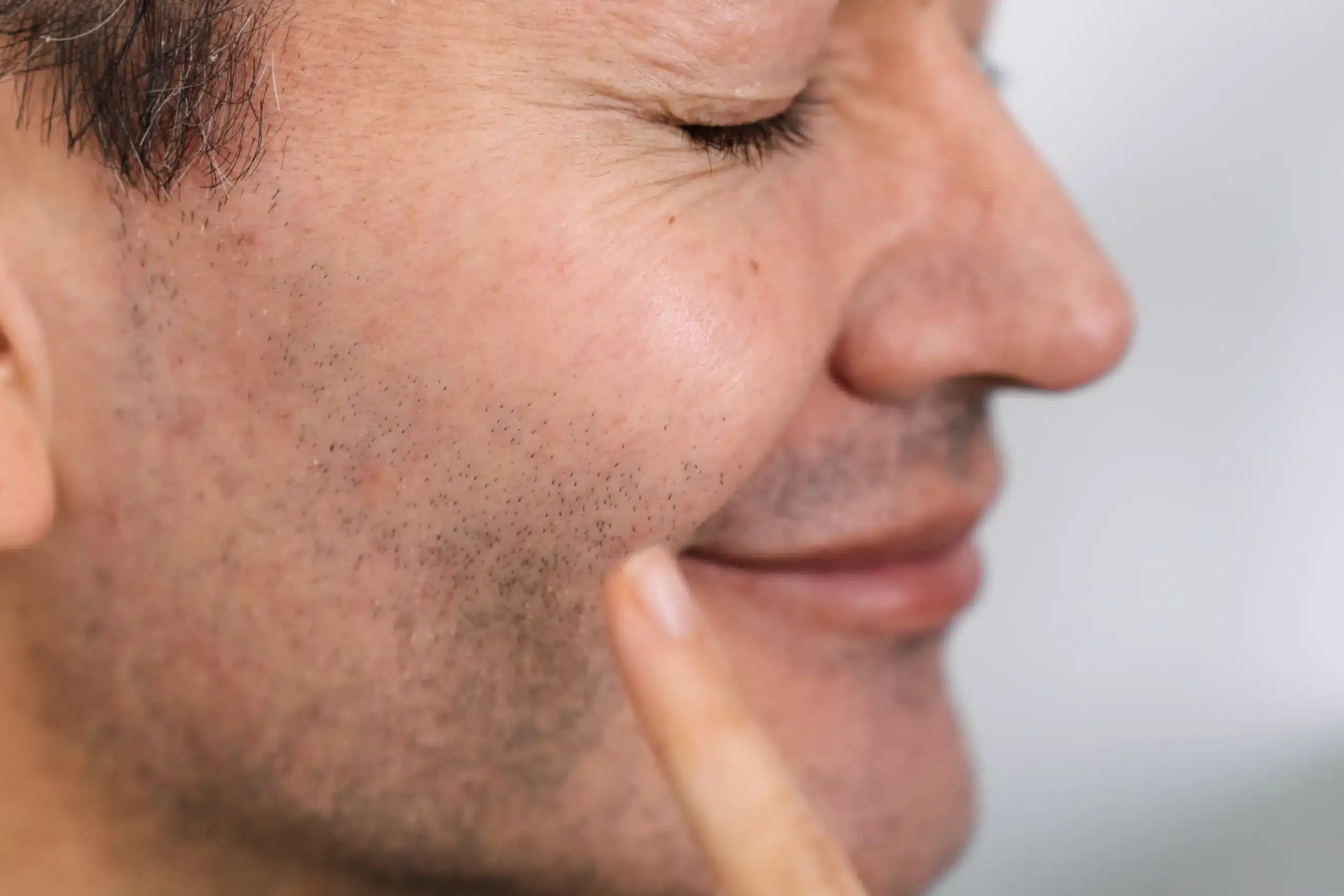
Photo showing what lip migration looks like with these labels showing vermilion border: where your lip meets your skin; above the upper lip: where migration often shows first; Cupid’s bow: the peaks of the upper lip; Inner lip: where changes can push the lips forward

What does lip migration look like?

Lip migration is usually subtle at first, rather than obvious fullness. 

“The first thing people will often see is a bit of a shadow – you often catch it with downlighting,” says Lauren Hirschfield, Senior Cosmetic Nurse at Contour Clinics. “You’ll also notice it in photos or when you see your profile. It’s more noticeable when you see yourself in the distanced way that a photo can show you.”

Signs of lip migration can include:

  • A shadow above the upper lip: most noticeable under downlights or in photos taken from above
  • A line or crease forming: a soft ridge where the lip meets the skin
  • A moustache-like look: fullness that sits in the skin above the lip rather than in the lip itself
  • A blurred lip border: the vermilion border – the edge where your lip meets your skin – looks less crisp than it did
  • Changes inside the lip: small bumps in the inner lining that can push the lips forward

That last sign often surprises people. “A lot of people think migration is only on the outside of the lip, because that’s what they notice first,” says Lauren. “They don’t realise it can happen on the inside too – and it can force the lips to stick out.”

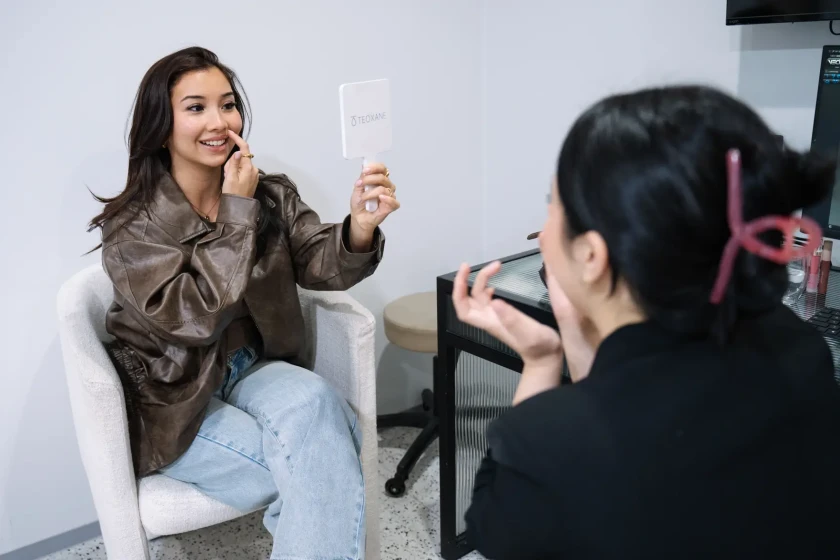
A simple way to check is to look at your lips in a mirror under an overhead light, then compare a recent photo with one from a year or two ago. Looking at your profile can also show whether your lips sit further forward than they used to.

Graphic showing the Dr Harris classification of lip treatment migration with class 1 - normal, class 2 - ledge, class 3 - shelf, class 4 - plateau

How is lip migration classified?

Practitioners sometimes describe lip migration in four grades, using a classification developed by cosmetic doctor Dr Steven Harris (Love et al., 2023). Each grade reflects how far beyond the lip border the previous treatment has settled.

Grade What it can look like
Class 1: Normal A crisp lip border, with nothing sitting in the skin above it
Class 2: Ledge A small ridge forms just above the lip border
Class 3: Shelf The ridge becomes a more defined shelf that sits forward of the upper lip
Class 4: Plateau The lip and the skin above it blend into one flattened area that projects forward, most visible in profile

Grades are a way of describing what your practitioner sees. Your assessment still looks at your lips and face as a whole.

Lip swelling vs lip migration explained by cosmetic nurses at Contour Clinics

Is it swelling or lip migration?

Timing is the clearest difference. Normal swelling appears straight after treatment and usually settles within 3–5 days. Migration tends to show in the weeks that follow.

Normal swelling after treatment Lip migration
When it appears Straight after treatment In the weeks after treatment
How long it lasts Redness and tenderness for up to 24 hours. Swelling usually settles within 3–5 days. Any bruising settles within 3–7 days Doesn’t resolve quickly with waiting
What it can look like Softer, more even fullness across the treated area, with possible redness or bruising A shadow, ridge or blurred border above the lip that doesn’t change, or bumps inside the lip

It’s worth allowing around two weeks before judging how your lips have settled. Recovery can vary with the type of treatment used and whether there’s any bruising.

Some unevenness in the first week or two is also part of the process. “Uneven lips are so normal and so common – more often than not, it’s to be expected,” says Lauren. “Most people’s lips are naturally asymmetrical, so we often place more on one side than the other to even them.”

If you’re still unsure after around two weeks, a review appointment is the simplest way to find out. If something doesn’t feel right before then, contact your clinic straight away.

What causes lip migration?

What causes lip migration?

Lip migration is most often linked to how and when treatment was placed, rather than to anything wrong with your lips. The main contributing factors are:

  • Top ups too close together: adding more before the previous treatment has had time to settle can lead to overfilled lips. “You wouldn’t keep adding to the lips every week or every month,” says Mary. “Each treatment needs time to settle.”
  • Placement without enough anatomical knowledge: “It comes down to anatomy,” explains Mary. “Knowing the lip’s structure well enough to place treatment where it belongs – and knowing when to wait before adding more.”
  • Lumps: a localised area that has settled unevenly can create lumpy lips or pull the lip shape off balance.
  • The surrounding area not being supported: “If you’re not supporting the whole perioral part of the face, that’s when shadows are created,” says Lauren. “The face needs to flow – that fluidity can’t be compromised.”

All of these come down to how treatment is planned and placed. That’s why it matters that your practitioner understands your anatomy and can adapt their approach to suit.

Everyday movement plays a part in planning, but it’s not a direct cause of lip migration. Your lips are constantly moving when you talk, eat and smile. A skilled practitioner accounts for this by supporting the surrounding tissues, so the result moves naturally with your face.

Why it's hard to see how your lips have changed after treatment

Why can it be hard to see how your lips have changed?

Our sense of what looks normal adjusts to what we see every day – including our own reflection. That’s why lip changes can build up without feeling obvious.

A 2025 University of Sydney study supports this. Participants rated faces after viewing images with digitally altered lip sizes. Their sense of the most attractive lip size shifted towards whatever they’d just seen. The researchers suggested this shift could contribute to what they called lip dysmorphia. A separate qualitative study of women with significantly altered lip shapes found a similar pattern, which the researchers described as perceptual drift.

Lauren sees the same thing in clinic. Once something new becomes familiar, it quickly starts to feel like your baseline and it becomes harder to remember how your lips looked before. This is where 3D and clinical photography play a role in our assessment when you first come in to see a Contour Clinics practitioner. If you loved your lips at first and now feel differently about what looks normal, that isn’t a mistake on your part – it’s simply how perception works.

Is it ok to have your lips repeatedly treated long term

Is having lips treated long term a problem?

Long-term treatment isn’t the problem in itself. What matters is the timing between treatments and how each one is placed.

“Ongoing treatment isn’t the issue,” says Mary. “When the lips are assessed properly and treated with the right timing and technique, many people maintain their lips for years.”

How often lip treatment is appropriate depends on your anatomy and how previous treatment has settled. Your practitioner will plan this with you rather than following a fixed schedule.

Can migrated lips be corrected without starting over

Can migrated lips be corrected without starting over?

Often, yes – depending on what your assessment shows. 

“Starting over takes time and money. There’s a real mental load too,” says Mary. “People often put it off and keep living with lips they’re unhappy with – but there are usually other ways to correct them.”

For many people, a more targeted approach may be possible, including:

  • Spot treatment: addressing a specific lump or uneven area, rather than the whole lip
  • Balancing the opposite side: when one side looks fuller, the answer isn’t always to take away from it. “Sometimes the answer is looking at the opposite side and bringing that into balance,” says Mary.
  • Rebalancing with your whole face in mind: looking at how your lips sit with your chin shape, projection and symmetry. This is about proportion – it doesn’t mean adding treatment elsewhere by default.

You can read more about how this is approached on our cosmetic correction page.

Lip migration correction or starting over - how is it decided?

Lip migration correction or starting over: how is it decided?

It’s determined at your assessment when your practitioner considers several factors together. No single one decides whether correction or starting over is the better path.

Factor Correction may be considered when… Starting over may be considered when…
How previous treatment has settled There’s a specific lump or uneven area to address Treatment has built up over time and adding more would do more harm than good
Where it sits Changes are localised and can be addressed on their own Treatment sits well beyond the lip border, or inside the lip where it pushes the lips forward
Symmetry One side can be brought into balance by supporting the other Adding more would affect the natural symmetries of your face
Facial balance Your lips can be brought back into proportion with your chin and profile Adding more would distort the natural shape of your lip
Upcoming events Your practitioner plans timing around the date Time is needed for your lips to settle before any further treatment, so planning works back from the date

The right path depends on your assessment. Your practitioner will explain what they’ve seen and why they’re recommending it. 

What is a Lip Flip

When might starting over still be considered?

Starting over may be considered when adding more would affect your face’s natural balance rather than restore it. 

“When adding any more would do more harm than good, or when it’s going to affect the natural symmetries of your face,” explains Lauren. “If you want a natural look that flows with the curvatures of your face, adding more can almost distort the natural shape of your lip.”

If this is the case, your practitioner will explain why and how much time your lips need to settle before any further treatment. “If you’re planning around a big event, work backwards from the date,” says Lauren. “You need to allow time for natural healing before treating again.”

How are your lips assessed for migration

How are your lips assessed for migration?

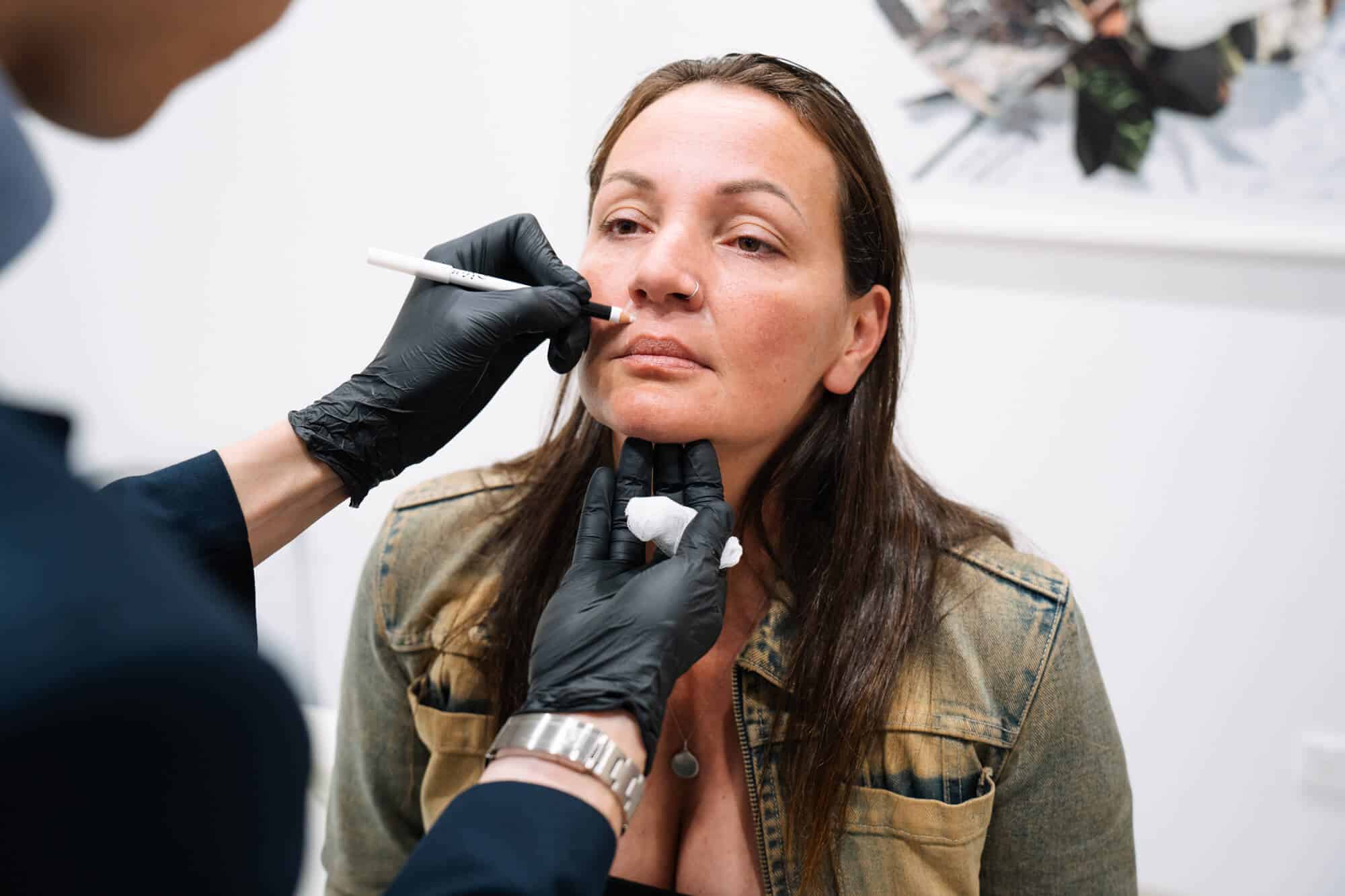
Your lips are assessed as part of your whole face – how it looks and how it moves.

“Your face is 3D, not 2D, so we assess it like that,” says Mary.

Your practitioner will look at:

  • How previous treatment has settled: inside and outside the lip
  • Your upper lip length: the space between your nose and lip, which naturally lengthens with age
  • Your chin and profile: how your lips sit in relation to the lower face
  • Symmetry: how each side of the lip compares and where balance can be restored

Where appropriate, Vectra 3D imaging may be used to map your proportions and create a baseline.

What happens in a lip correction consultation?

What happens in a lip correction consultation?

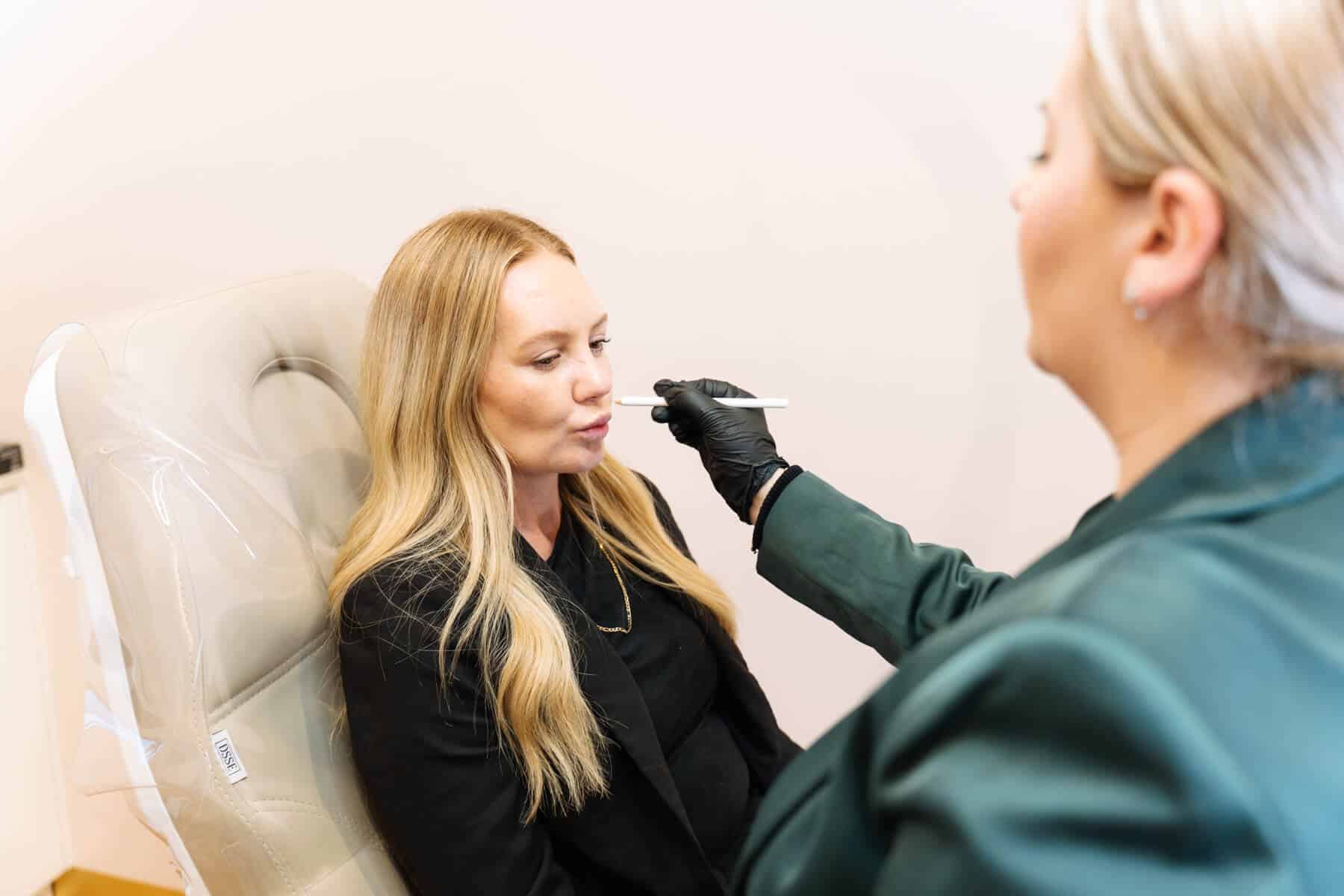
Your practitioner will start by asking what you liked about your lips originally and what’s changed. They’ll assess your lips alongside your chin, profile, upper lip length and overall facial proportions and look at how any previous treatment has settled. From there, they’ll talk you through the options that may suit you. These may not include starting over. At Contour Clinics, we’ll provide you with a written, tailored treatment plan so you can decide without pressure and in your own time. 

BOOK A COSMETIC CORRECTION CONSULTATION 

Results may vary between individuals and depend on personal goals, baseline characteristics, and responses to treatment. A consultation with a qualified medical professional is recommended to determine if this treatment is suitable for you.

The Contour Medical Team

About The Contour Medical Team

This article has been prepared for general informational purposes only. It does not constitute medical advice, diagnosis, or a treatment recommendation. Suitability for any cosmetic treatment varies between individuals and should be assessed in a 1:1 consultation with a qualified practitioner. If you have questions about your specific situation, we encourage you to book a consultation or contact our team directly.

Are You Ready?

Book Now

Ready to book? Still have questions? Leave us a message and we will get back to you as soon as possible.


or call us on 1300 233 803