Skip to Content Skip to Navigation

The Blog Regenerative Skin Treatment: A Doctor-Led Guide to the Options

In brief

  • Regenerative skin treatment refers to treatments that work with the skin’s own renewal processes rather than filling, freezing, or resurfacing
  • Includes bioremodellers, polynucleotide treatments (including Rejuran), collagen-stimulating biostimulators, exosomes, and microneedling-based approaches
  • The terminology is genuinely confusing – and the industry contributes to that. Biostimulator, bioremodeller, and skin booster are sometimes used interchangeably even though they’re different treatments. 
  • The evidence base varies significantly by treatment, with bioremodellers and biostimulators having the longest track records and exosomes being the newest and most actively researched

If you’ve been researching skin treatments recently, you may have come across terms like biostimulator, bioremodeller, skin booster, collagen induction, exosome therapy, or simply regenerative skin treatment. You may also have noticed that different clinics use these terms to mean different things, sometimes within the same paragraph.

It can be really confusing. The terminology in this category genuinely is messy, and marketing blurs the definitions. This guide explains what regenerative skin treatment actually means, what the main options are in Australia, and what the considered medical view is on each.

What regenerative skin treatments are

What Regenerative Skin Treatment Actually Means

Most cosmetic skin treatments fall into one of three broad approaches:

  1. Filling and relaxing – treatments that add volume, reduce muscle activity, or lift tissue. These work by directly altering the structure or movement of the face.
  2. Resurfacing – lasers, peels, dermabrasion. These work by removing or remodelling the surface of the skin, prompting it to heal and renew in the process.
  3. Regenerative. Regenerative skin treatments work with the skin’s own biological renewal processes – the production of collagen, elastin, and the cellular communication that supports healthy skin function. Rather than filling a wrinkle or resurfacing a layer, they aim to support the skin’s underlying biology.

That last category is what this guide focuses on. 

Biostimulator vs bioremodeller vs skin booster explained

The Terminology Problem - Why it Matters

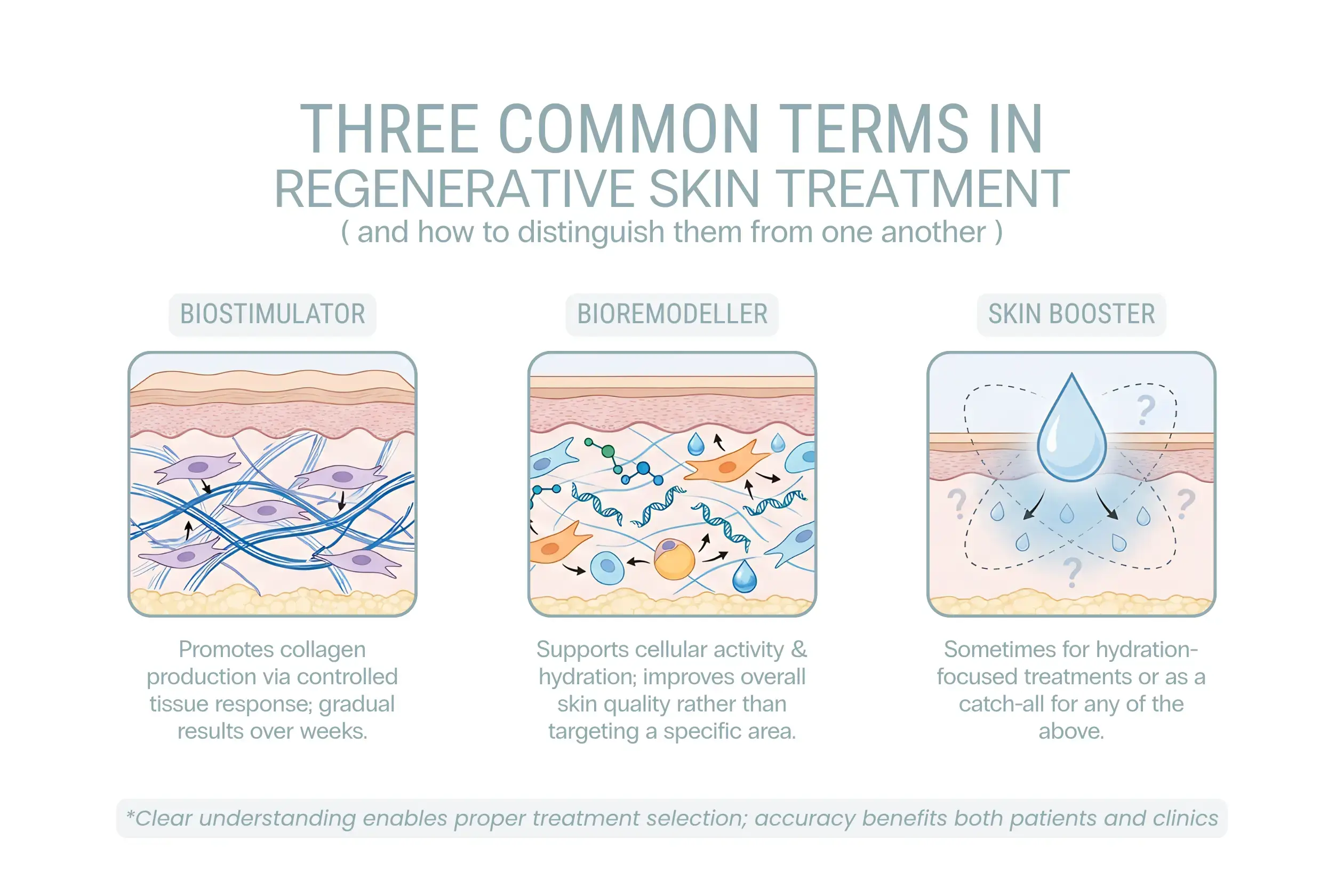
Within regenerative skin treatment, we’re the first to admit – the language is inconsistent. Three terms come up most often. Here are their accurate definitions:

Biostimulator – treatments that prompt the skin to produce its own collagen over time, typically through a controlled tissue response. The approach is gradual – results unfold across weeks rather than appearing immediately.

Bioremodeller – treatments that distribute through the skin to support cellular activity and hydration rather than targeting a specific area. The aim is overall skin quality rather than structure or volume.

Skin booster – the loosest of the three terms, sometimes used for hydration-focused treatments and sometimes as a catch-all for any of the above.

Many clinics use these terms interchangeably. Some use biostimulator to describe treatments that are more accurately bioremodellers. Some use skin booster to describe everything from a basic hydration treatment to a polynucleotide procedure.

Why does this matter? Because the treatments are different. They have their own mechanisms, evidence bases, ideal patient profiles, and price points. Understanding which is actually which makes the difference between an informed decision and a confused one.

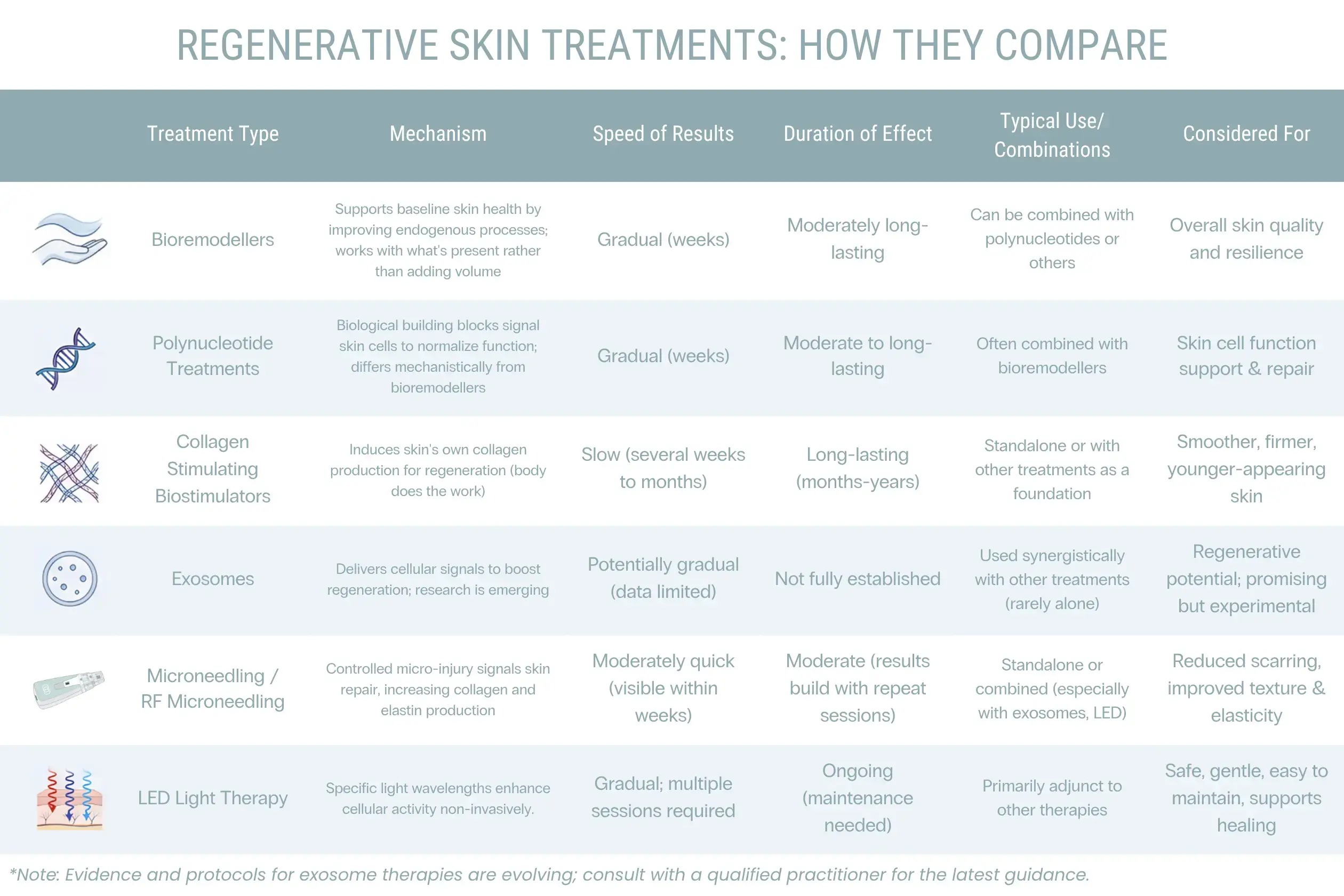
Biostimulator vs bioremodeller vs skin booster - table comparing treatment, mechanism, speed of results, duration of effect and typical use. Explained by cosmetic doctors at Contour Clinics

The Six Main Types of Regenerative Skin Treatment

1. Bioremodellers

TL;DR: Bioremodellers are less about changing a specific feature and more about supporting your skin’s baseline health. They work with what’s already there rather than adding to it.

The clinical approach typically involves two to three sessions over monthly intervals. Skin quality improvements unfold across weeks as the treatment works through the tissue.

The evidence base is solid and growing. Published clinical studies have reported improvements in skin elasticity, hydration, and overall quality across multiple sessions.

Read more about face bioremodelling →

2. Polynucleotide Treatments

TL;DR: Polynucleotides are biological building blocks that act as signals to your skin cells, supporting their normal function. The mechanism is different from bioremodellers, which is part of why some patients use them in combination.

Polynucleotide treatments (Rejuran being the most widely known in Australia) use fragments of DNA-derived molecules – typically from salmon sperm – to support skin biology. The polynucleotides are studied for their role in cellular communication, anti-inflammatory pathways, and supporting skin regeneration.

A 2024 review in clinical dermatology literature analysed polynucleotide treatments for skin rejuvenation and reported improvements in skin elasticity, hydration, and wrinkle parameters. with most patients receiving a course of three to four sessions. The evidence base is smaller than for bioremodellers but is genuinely growing.

Read more about Rejuran →

3. Collagen Stimulating Biostimulators

TL;DR: Biostimulators ask your body to do the work rather than doing it directly. The results arrive gradually, and typically last longer than treatments that provide an immediate effect.

Rather than supporting what’s already in the skin, collagen stimulating biostimulators  prompt your body to produce its own new collagen over time – typically across a course of sessions spaced weeks apart.

The approach is gradual by design. The treatment works by creating a controlled response in the tissue, and the visible changes unfold over months as the skin responds. Some biostimulators also provide an element of immediate structural support alongside the longer-term collagen-building effect.

The evidence base is well-established. A 2024 systematic review in the plastic and reconstructive surgery literature evaluated one class of collagen-stimulating biostimulator and reported significant improvements in skin firmness, thickness, and elasticity across the published studies.

Read more about collagen stimulation →

Skin needling treatment for mature skin

4. Exosomes

TL;DR: Exosomes are the latest regenerative treatment. The research is genuinely promising, but the evidence base is still maturing. They work best in combination with other treatments; less so as a standalone.

The newest entry to the regenerative skin treatment category. Exosomes are nano-sized extracellular vesicles – tiny biological packages released by cells that carry signalling molecules between cells. 

Exosomes used in skin treatments are derived from stem cells (typically mesenchymal stem cells), and they’re studied for the role those signalling molecules play in tissue communication and cellular renewal.

The evidence base is early but accumulating:

  • A 2024 systematic review of exosomes in cosmetic dermatology found early-stage clinical evidence supporting exosomes for skin rejuvenation and related indications, while noting that the field is still working toward more standardised research.
  • A 2025 systematic review specifically on skin rejuvenation reached similar conclusions: published research points toward improvements in skin elasticity, hydration, and pigmentation, with favourable safety profiles, but exosomes haven’t yet built the depth of research that supports the more established regenerative treatments.

In Australia, exosomes are not approved by the TGA for delivery by injection. Clinics following TGA guidance deliver exosomes topically, typically after a microneedling or laser procedure that creates micro-channels in the skin.

Read more about exosomes for skin →

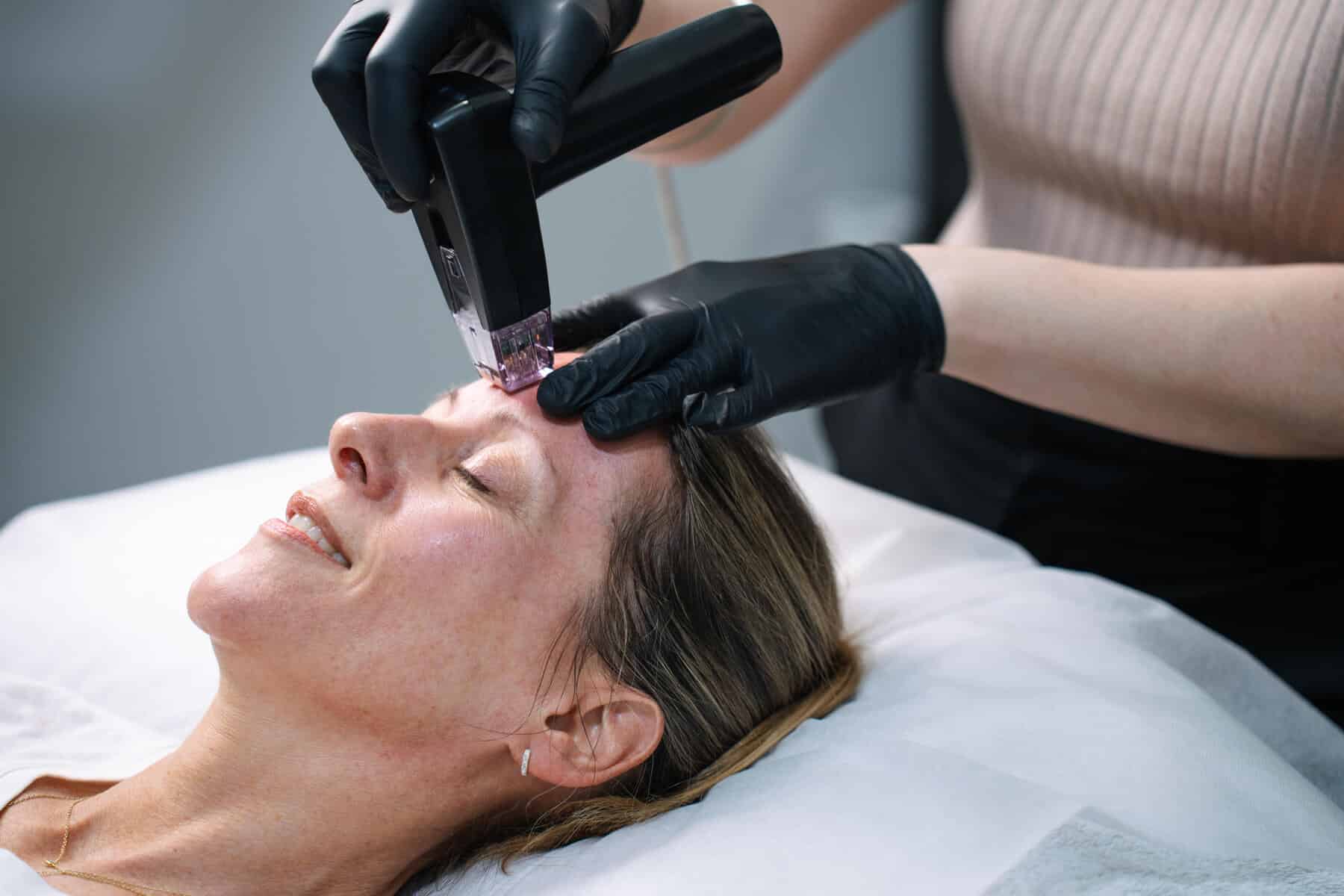
5. Microneedling and RF Microneedling

TL;DR: Microneedling and RF microneedling give your skin a controlled, structured signal to repair itself. The repair process produces new collagen and elastin – which is the goal.Microneedling is mechanical regeneration. The controlled creation of microscopic channels in the skin creates a healing response that includes new collagen and elastin production. Radiofrequency microneedling adds controlled heat to the channels, which extends the depth of the regenerative response into the dermis.

The evidence base for both is well-established. Microneedling has been used in cosmetic medicine for over twenty years, and RF microneedling has accumulated significant clinical research over the last decade demonstrating effects on skin texture, fine lines, and acne scarring.

At Contour Clinics, skin needling is offered with Dermapen, and RF microneedling with Morpheus8 and Potenza. These treatments are also commonly paired with exosomes, because the micro-channels they create provide an effective route for topical exosome delivery.

Read more about Dermapen skin needling, Morpheus8, or Potenza →

6. LED Light Therapy

LED light therapy uses specific wavelengths of light to support cellular activity in the skin. It’s the gentlest option on this list – non-invasive, requires multiple sessions, and is most often used alongside other treatments rather than as a primary intervention. It’s also the easiest regenerative approach to maintain ongoing.

Read more about LED light therapy →

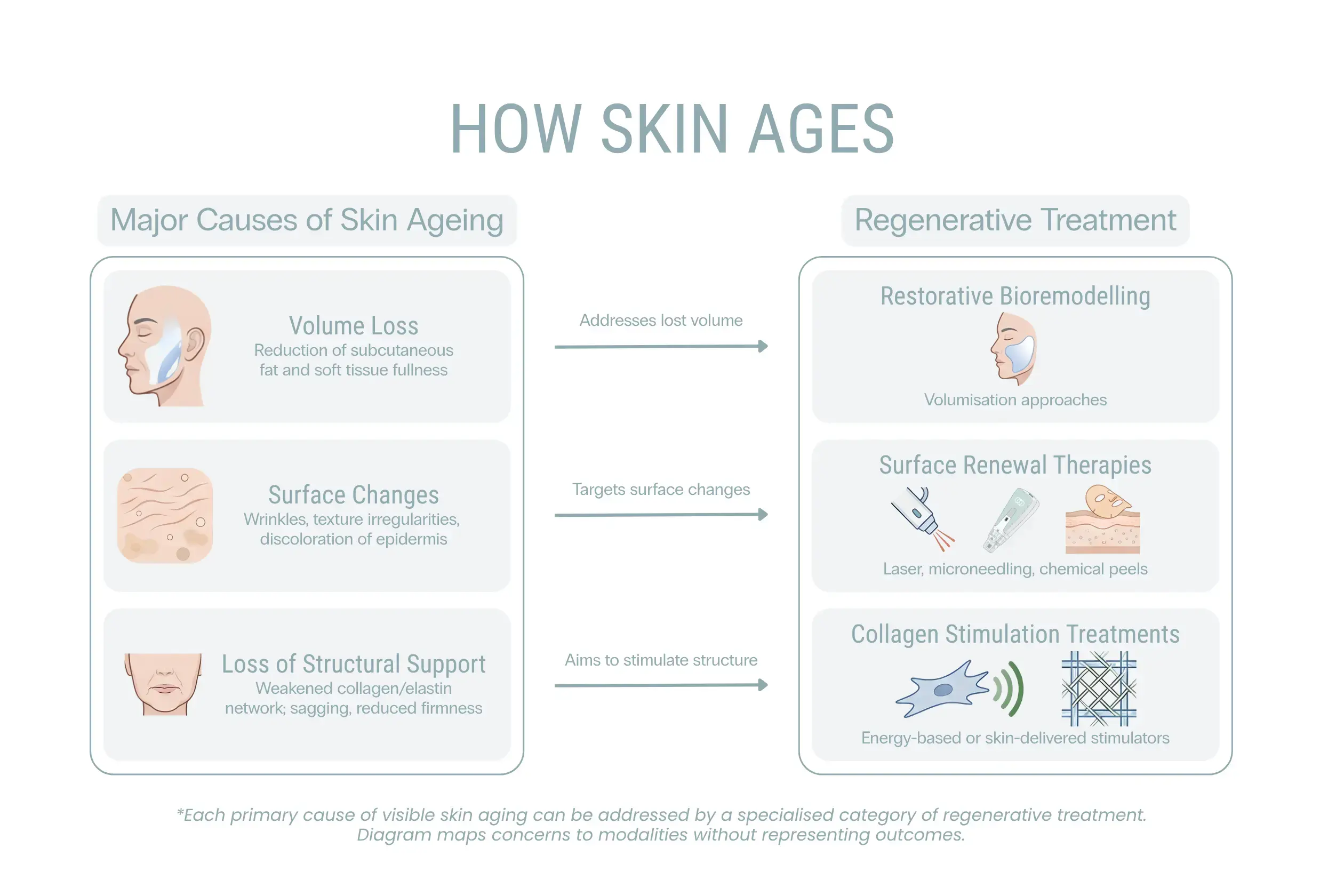
Diagram showing how skin ages with causes and regenerative treatment options with cosmetic doctors at Contour Clinics

How to Think About Choosing Between Them

There isn’t one “right”  regenerative treatment for everyone. The choice depends on a few things worth thinking through.

The Concern

Sagging skin and structural changes respond differently than skin texture, hydration, or fine lines. Pigmentation, redness, and post-procedure recovery respond to a different subset again. The treatment needs to match what’s actually happening in the skin.

The Stage

Earlier-stage skin changes often respond well to bioremodellers, polynucleotides, or exosomes used as add-ons. Later-stage structural concerns may benefit from collagen-stimulating biostimulators that address volume and firmness more directly.

The Combination

Most clinical experience points toward combinations outperforming single approaches. Bioremodellers and exosomes can complement each other. Polynucleotides are sometimes used alongside other regenerative treatments. Microneedling is commonly paired with exosomes. The right combination is individual, not formulaic.

The Commitment

Some treatments require an initial course of multiple sessions over weeks. Others are single sessions with results unfolding over months. Some require ongoing maintenance; others have longer-lasting effects. Worth knowing what you’re committing to before you start.

The Evidence
Bioremodellers and collagen-stimulating biostimulators have substantial peer-reviewed research behind them. Polynucleotides have a growing evidence base. Exosomes have the most exciting recent research but the smallest body of long-term data. Different patients are comfortable with different stages of evidence.

Why a Doctor-Led Consultation Is Important for Regenerative Skin Treatments

Why a Doctor-Led Consultation Is Important for Regenerative Skin Treatments

The cosmetic medicine market moves fast, and regenerative treatments have moved through it faster than most. Marketing online has been louder than clinical research. The claims you’ll see vary widely depending on who’s making them. A measured, doctor-led conversation is the antidote to the hype.

A doctor-led consultation for regenerative skin treatment does a few things that an online product purchase or a non-medical setting doesn’t:

  • A clinical assessment of your skin, including what’s actually driving the changes you’ve been noticing
  • Medical context – any medications, underlying skin conditions, or factors relevant to your situation
  • A discussion of the regenerative options grounded in current evidence rather than marketing
  • Honest framing of where the evidence base is strong, where it’s developing, and what’s realistic for your skin specifically
  • Clear advice on what’s appropriate for you and your goals, including the option of recommending no treatment at all

The purpose of a doctor-led approach isn’t to recommend more treatments. It’s to help you understand whether what you’ve been considering is actually the right option for you and if it will help you achieve your goals.

Rejuran treatment at Crows Nest cosmetic clinic

Regenerative Skin Treatments at Contour Clinics

At Contour, regenerative skin consultations across our Sydney and Brisbane clinics are doctor-led, evidence-based, and designed to give patients an honest picture of what’s worth doing rather than a sales pitch for a specific treatment. We offer the regenerative options included in this guide, and the right starting point depends on your individual situation.

If you’re wondering whether to do something about skin quality, texture, fine lines, hydration, or general skin ageing, a skin consultation is a reasonable place to start. The consultation is a conversation about your specific situation – what’s happening, what’s driving it, and what’s actually worth considering. There’s no pressure to commit to anything on the day.

The right approach, or combination of approaches, depends on your individual assessment. If you’re not sure which is the right starting point, book a consultation and we’ll work it out together.

Your consultation is complimentary. A $75 deposit secures your booking and is credited to your treatment if you proceed or refunded in full if you decide not to. How deposits work.

Not ready to book? Still have questions? Contact our Sydney or Brisbane teams and we’ll answer them properly.

The Contour Medical Team

About The Contour Medical Team

This article has been prepared for general informational purposes only. It does not constitute medical advice, diagnosis, or a treatment recommendation. Suitability for any cosmetic treatment varies between individuals and should be assessed in a 1:1 consultation with a qualified practitioner. If you have questions about your specific situation, we encourage you to book a consultation or contact our team directly.

Are You Ready?

Book Now

Ready to book? Still have questions? Leave us a message and we will get back to you as soon as possible.


or call us on 1300 233 803